Poker Online: Rules, Free Games and Real Money Sites
Last updated: June 2025 · Reviewed by: Nadia Farzana Haque, Head of Sports & iGaming Content
Quick summary:

Last updated: June 2025 · Reviewed by: Nadia Farzana Haque, Head of Sports & iGaming Content
Quick summary:
Poker is a strategic card game built on incomplete information. Long-term results hinge on mathematical decisions, not pure chance. That distinction matters. Unlike traditional online casino formats — where the house always holds a statistical edge — online poker pits players directly against each other.
"Over the past several years we have analysed dozens of platforms and approaches. The main takeaway: a safe start in poker begins with learning the rules and understanding the risks. This is an intellectual discipline that demands bankroll management, not a shortcut to quick cash. Our goal is to give an objective picture of how the industry works so that players can make informed decisions." — Nadia Farzana Haque, Head of Sports & iGaming Content, iGaming Bangladesh
The poker industry is valued at an estimated USD 3.86 billion in 2024, with market projections pointing toward approximately USD 6.90 billion by 2030 at a compound annual growth rate of 10.2%. — "Comprehensive Landscape of Online Poker" (2024)
Research confirms that more than 43% of the audience consists of users aged 18–34. For comparison, in online sports betting this age group accounts for roughly 23%, and in lotteries — about 18%. — "Comprehensive Landscape of Online Poker" (2024). This guide is designed to help readers understand the rules, formats and legal aspects of poker platforms, backed by verifiable research and established facts.

Poker is a family of card games where participants place bets based on the strength of their combinations. The pot goes to the holder of the best hand — or to the player whose bet forces everyone else to fold. The lasting popularity of online poker is driven by one thing above all: skill outweighs luck in the long run, giving players genuine control over their outcomes.
A landmark study covering 91,439 players over a 40-month period (more than 85 million hands dealt) demonstrated that individual poker results depend on self-control, risk-calculation ability and understanding of probabilities. The regression analysis yielded F = 5.98, p < 0.001 — confirming a statistically significant effect of skill on outcome. — "Comprehensive Landscape of Online Poker" (2024). Researchers specifically isolated three competencies: self-control, calculated risk management and precise hand selection grounded in probability theory.
In traditional casino games the outcome is determined by a random number generator (RNG). In a poker game, the decisions of participants shape the long-term result. Stronger players beat weaker ones through a sustained mathematical edge across thousands of hands. That's the core appeal — and the reason poker sites keep attracting new traffic year after year.
At the core of poker logic lies assembling the best five-card combination and sequential betting between opponents at the table. The role of players extends beyond collecting a strong hand — it includes managing the pot size through bets.
Every deal (hand) is accompanied by rounds of betting. The strength of a combination matters only against opponents who remain in the pot until the showdown. Actions at the table — bet, call, raise or fold — change the structure of the pot. Here's the thing that surprises many beginners: a player can win a hand without strong cards at all, if their aggressive line forces others to surrender. It is precisely this interaction mechanic that distinguishes poker from every other card game.
The key differences between digital poker and live play in a casino or home tournaments lie in deal speed, access to statistics and the absence of physical tells. The software of poker sites automates all technical dealer routines — shuffling, dealing, pot calculation.
Multi-table online poker lets you play 60 to 100+ hands per hour at a single table. Online deals run roughly 2–3 times faster than in live games, which substantially affects both strategy and player psychology. — "Comprehensive Landscape of Online Poker" (2024). For comparison, live playing in a casino yields about 25–40 hands per hour, and home games are even slower due to manual card shuffling.
Digital formats give access to hand histories and HUD programs for analysing opponents' actions. In live play, participants rely only on memory and the physical reactions of their opponents — chip handling, pauses before bets, posture shifts. Online, these physical tells are replaced by bet-timing patterns and sizing tendencies.
Basic poker rules dictate a strict clockwise order of action, mandatory bets (blinds) and a hierarchy of combinations. Before you play poker for money, you need to internalise the structure of a hand until it becomes automatic. No shortcuts here.
Action passes from player to player. On your turn you may fold, call the current bet or raise it. The hand is won by the player who shows the strongest poker combination at showdown, or by the last player remaining after everyone else has folded.

A standard hand includes the posting of blinds (small blind and big blind) and four betting streets: preflop, flop, turn and river. Blinds create the initial pot that players will compete for.
At the start, two players post mandatory blind bets. Then each participant receives their hole cards.
In each phase, players evaluate the strength of the hand they are building and decide how much to invest in the pot. The beauty of this structure is that every street gives you new information — and new decisions to make.
Hand Rankings (strongest to weakest):
Texas Hold'em and Omaha differ in the number of hole cards and the strictness of rules for using them. For beginners, Texas Hold'em is objectively simpler as a starting point — fewer variables, cleaner math.
In Texas Hold'em, each player receives 2 hole cards. They can use any combination of their own and the five community cards to form the best hand. In Omaha, each player receives 4 hole cards. Omaha rules strictly require using exactly two hole cards and exactly three community cards. The greater number of unique combinations in Omaha means winning hands there tend to be stronger, which complicates mathematical calculations for less experienced players.
A practical note: if you are just learning poker rules, spend your first 5,000–10,000 hands exclusively on Hold'em. Omaha rewards experience, and jumping in too early often leads to frustration and bankroll damage.
Hand Frequency Table (Texas Hold'em, 7-card probabilities)
| Hand | Composition | Probability (%) |
|---|---|---|
| Royal Flush | A-K-Q-J-10 of one suit | 0.0032% |
| Straight Flush | Five consecutive cards of one suit | 0.0279% |
| Four of a Kind | Four cards of the same rank | 0.168% |
| Full House | Three of one rank + a pair | 2.60% |
| Flush | Five cards of one suit (non-sequential) | 3.03% |
| Straight | Five consecutive cards (mixed suits) | 4.62% |
| Three of a Kind | Three cards of one rank | 4.83% |
| Two Pair | Two pairs of different ranks | 23.50% |
Note: These figures reflect 7-card Texas Hold'em probabilities (the chance of making the hand from any seven cards dealt). Some published tables use 5-card probabilities, which are significantly different. Always check which model a source is using. Updated June 2025.

Online poker games fall into two broad categories: open cash games and multi-table tournaments (MTT, Sit & Go). The choice of format depends entirely on how much time you have and your tolerance for variance in payouts.
The structural difference is straightforward. In a cash game, chips are equivalent to money in your account — you can leave the table at any second. In tournaments, you pay a fixed buy-in for a starting stack. Play continues until elimination or victory, and prize money is distributed among a small percentage of top finishers. Both formats reward different skill sets, which is why many experienced players specialise in one or the other.

The level of risk (stakes) in cash games is fixed by the blind size of the table, while in tournaments blinds constantly increase, accelerating the pace. Freeroll tournaments offer entry with no buy-in, allowing you to compete for the sponsor's prize pool at zero cost.
In cash games, limits are stable. A player can re-buy chips if they lose their stack. The tournament process psychologically pressures players through rising blinds that gradually consume stacks, forcing opponents to make difficult decisions and exit the field faster. Free freerolls are standard tournaments minus the financial risk on entry — ideal for completing a beginner's educational checklist.
Major online tournament series to know include WCOOP and SCOOP at PokerStars, and events like The Venom at ACR Poker, which regularly features guarantees of USD 10 million or more.
Additional formats worth exploring:
Today, roughly 70% of global player traffic is generated by mobile devices. In certain markets — Canada, for example — the mobile share exceeds 80%, and portrait orientation has become the standard design for platforms. — "Comprehensive Landscape of Online Poker" (2024).
Apps offer portrait-mode tables for one-handed control, but browser clients on PC retain their advantage for multi-tabling across many tables simultaneously. Traffic concentrates in mobile pools, reducing wait times for opponents. Around 50% of players remain active month-to-month, and among experienced users the retention rate reaches 87%. — "Comprehensive Landscape of Online Poker" (2024).
However, desktop platforms remain essential for professionals who need to overlay HUD statistics — data that simply does not fit on smartphone screens. If you play online poker primarily for learning, mobile is fine. If you grind seriously, you will eventually want a proper monitor setup.

Playing poker online free (with play-money chips) is useful exclusively for familiarising yourself with the software, interface and basic hand structure. Practice in demo mode helps at the start, but staying there too long builds dangerous strategic habits. Let me explain why.
Play-money mode removes the psychological barrier of the first session. You can press buttons, test bet sliders and learn the order of action without fear of mistakes. But the free mode has a structural flaw — the absence of any cost for errors undermines the very essence of what poker is. When mistakes are free, they stop feeling like mistakes.

Free games are effective for memorising rules but completely useless for training bluffs and reading opponents. When nothing is at stake, players lose the incentive to fold and will call bets with any combination.
In poker mathematics, "fold equity" — the probability that an opponent will surrender after your bet — plays a critical role. In free games this probability approaches zero. Research confirms that without a financial incentive, players fold less frequently, which distorts the learning of bluff mechanics and opponent-reading skills. — "Comprehensive Landscape of Online Poker" (2024).
The educational value ends precisely when the user stops confusing hand rankings.
In the early weeks of developing an educational course on iGaming for the South Asian region, our editorial team encountered the problem of free-play overvaluation. Newcomers were spending months in demo modes. We introduced a strict skill checklist — hand rankings, pot odds, position awareness. As a result, the transition time to microstakes shortened noticeably, and the sustainability of bankrolls during the initial phase improved. (Exact improvement percentages are under internal review and will be published once verified.)
Readiness to start playing at real tables is determined by four indicators: pot-odds calculation, strict bankroll management, session-time discipline and a stable emotional baseline.
Disclaimer: The information below is general in nature and does not replace a consultation with a financial management specialist. Playing for real money carries the risk of losing funds.

According to a study, it takes a newcomer no fewer than seven months of consistent practice to reach the level of an experienced player. — "Comprehensive Landscape of Online Poker" (2024).
Seven months. That number surprises people, but it makes sense when you consider how many situations poker presents. The transition is justified if:
Transitioning to online poker real money changes the architecture of decision-making. Room commissions (rake), the power of bonuses and the hard psychological pressure of losing real capital all come into play at once.
In a real game, every chip has a financial equivalent. This radically alters the psychology of opponents: they fold more often, less frequently overvalue weak combinations and pay closer attention to mathematics. The game's economy revolves around rake (the commission the platform takes from each pot) and rakeback — the percentage of that commission returned to the player. Understanding this economy is, honestly, just as important as understanding hand rankings.
Welcome bonuses in poker are rarely delivered instantly. They require gradual clearing through generating rake at the tables.
Welcome offers are typically released in increments. For example, for every USD 10 in rake paid, the user unlocks USD 2 from the bonus pool into their balance. This means collecting the full bonus amount may require playing hundreds, sometimes thousands of hands. Always read the terms — they often include strict time limits of 30–90 days.
How the best rooms compare on bonuses (2025):
| Room | Welcome Bonus | Clearing Mechanic | Time Limit |
|---|---|---|---|
| ACR Poker | 100% up to USD 2,000 | USD 1 per 27.5 Award Points | 60 days |
| Black Chip Poker | 100% up to USD 2,000 | USD 1 per 27.5 Award Points | 60 days |
| BetOnline | 100% up to USD 1,000 (code POKER1000) | USD 5 per USD 50 in rake | 30 days |
| CoinPoker | 150% up to USD 2,000 | 15% daily guaranteed rakeback | Ongoing |
Bonus amounts and terms change frequently. Verify current offers directly on each platform before depositing.
Withdrawal speed and deposit convenience are key reliability criteria for any poker site. According to industry reports, cryptocurrency accounts for approximately 60% of transactions on major US-facing poker networks. — "Comprehensive Landscape of Online Poker" (2024).
Crypto solves the problem of delays with traditional banks. Classic card deposits are subject to regional limits and blocks, especially in jurisdictions with unstable regulation. Crypto cashiers deliver withdrawals within a few hours. E-wallets are also reliable but often require lengthy verification to increase limits.
Payment methods and local context for South Asian players: Readers in Bangladesh should be aware that standard Visa/Mastercard transactions may be declined by issuing banks due to restrictions on outbound gambling-related transfers. Mobile wallets such as bKash and Nagad are not directly supported by most offshore poker rooms. The most reliable workaround is peer-to-peer cryptocurrency purchase via a local exchange, followed by a direct crypto deposit. Always confirm that the method you choose complies with your country's regulations.
Legal disclaimer: Playing for money involves financial risks. Only persons aged 18+ are permitted to play. Online platforms do not guarantee income. Before funding an account, confirm the legality of play from your IP address in accordance with the laws of Bangladesh (or your country of residence) and strictly follow Responsible Gaming principles — cooling-off periods, deposit limits, self-exclusion. The legality of real-money online poker varies by jurisdiction. Before depositing, make sure your actions comply with the law in your country.
| Criterion | Practice Mode (Free) | Real Money Poker |
|---|---|---|
| Financial risk | None | High (direct losses) |
| Learning value | Technical only (rules) | Full (psychology + mathematics) |
| Bonuses & Rakeback | Virtual currency | Real money / tickets |
| Emotional pressure | Low | High (stress, tilt) |
| Opponent quality | Low (frequent all-ins) | Rational (risk analysis) |
Each room below was selected based on licence status, traffic volume, softness of player pool, bonus value and withdrawal speed. These are the platforms where beginners and intermediate players will find fair online poker games at the lowest stakes.
| Feature | Details |
|---|---|
| Traffic | 15,000+ players (7-day average) |
| Games | Hold'em, Omaha, Omaha Hi/Lo, 7-Card Stud, Bomb Pots |
| Stakes | USD 0.01/0.02 to USD 100/200 |
| Tournaments | 150+ daily · USD 12.5M Venom + USD 9M weekly GTDs |
| Softness | 4.9/5 — Bomb-pot tables and niche variants are highly exploitable |
| Welcome Bonus | 100% up to USD 2,000 |
Pros: Trusted since 2001; regularly scans for bots; up to 60% rakeback for VIP members; one of the best mobile poker apps on both iOS and Android.
Cons: No anonymous tables; relatively high Bitcoin cashout minimums.
ACR's massive tournament schedule — including frequent USD 12.5 million guaranteed events — draws large recreational fields, keeping the games beatable even at mid-stakes.
| Feature | Details |
|---|---|
| Traffic | 13,000+ players |
| Games | Hold'em, Omaha, Omaha Hi/Lo, 7-Card Stud |
| Stakes | USD 0.01/0.02 to USD 100/200 |
| Tournaments | 200+ daily · USD 12M weekly GTDs · USD 500K High Roller Sundays |
| Softness | 4.8/5 — Large tournament fields with many recreational players |
| Welcome Bonus | 100% up to USD 2,000 |
Pros: Massive MTT schedule including The Venom (USD 10M GTD); Hyper PKO tournaments; Million Dollar jackpot SNGs with buy-ins from USD 5 to USD 50; 60 days to clear the bonus.
Cons: P2P transfers can take up to 8 hours; some payout features have strict limitations.
Black Chip shares the Winning Poker Network with ACR, so traffic pools overlap — but BCP's tournament promotions and bounty events give it a distinct identity for MTT-focused players.
| Feature | Details |
|---|---|
| Traffic | 8,000+ at peak hours |
| Games | Hold'em, Omaha, Omaha Hi/Lo, 6+ Hold'em |
| Stakes | USD 0.02/0.05 to USD 25/50 |
| Tournaments | 100+ daily · Progressive Knockouts · USD 100K Sunday Showdown |
| Softness | 4.8/5 — Sportsbook players crossing over to poker tables |
| Welcome Bonus | 100% up to USD 1,000 + tournament tickets |
Pros: Bad Beat progressive jackpot; 6+ Hold'em for action junkies; USD 100K+ in leaderboard rewards; massive crossover traffic from the sportsbook keeps cash tables soft.
Cons: No anonymous tables; USD 50 minimum deposit for the bonus.
BetOnline's sportsbook brings in a steady flow of recreational players who try poker on a whim — making Friday-to-Sunday evenings some of the softest cash-game sessions you can find online.
Choosing safe poker sites is based on analysing the MGA/UKGC licence, traffic stability and the presence of independent RNG certificates. The platform must protect funds and provide a sufficient player pool at microstakes.
According to analytical data, market concentration is intensifying. PokerStars, GGPoker and partypoker together control the dominant share of global cash traffic. — "Comprehensive Landscape of Online Poker" (2024). A legitimate site deploys advanced AI systems to hunt bots and detect collusion, analysing keystroke patterns, timing histories and IP overlaps. If a poker site doesn't mention anti-cheating measures anywhere on its pages, that itself is a warning sign.

Traffic volume directly correlates with table wait time and the quality of opposition. A large pool of recreational players (amateurs) makes the platform attractive to newcomers — and, frankly, to everyone else too.
High traffic means the room has enough active games at the lowest stakes at any convenient hour. The average online poker session on the UK market lasts roughly 52 minutes, and 28% of players voluntarily set spending limits. — "Comprehensive Landscape of Online Poker" (2024). An excessive concentration of professional regulars at low-stakes tables turns learning into an endless process of bankroll depletion. The best rooms introduce anonymous tables and ban tracker usage to protect the pool from excessive data-mining.
For players in Bangladesh and the broader South Asian region, peak traffic hours on most international poker sites fall between 18:00 and 02:00 UTC — which translates to late evening and night local time. Planning sessions around these windows gives you access to the largest and softest player pools.
Protecting accounts from hacking and combating solvers (RTA — real-time assistance software) is the primary focus of room security teams, achieved through device fingerprinting and multi-factor authentication.
Machine-learning systems analyse millions of hands. They detect statistical anomalies in session win rates, identify devices with shared hardware fingerprints and penalise users for chip dumping. The sophistication of these systems has grown dramatically — some rooms now flag suspicious patterns within hours rather than weeks.
Research indicates that impulsivity is the strongest predictor of pathological poker play (β = 0.32, p < 0.001). — "Comprehensive Landscape of Online Poker" (2024). This finding underscores the importance of responsible-gaming tools — deposit limits, cooling-off periods and self-exclusion options — that reputable rooms are required to offer.
Fact-Check: Room Verification Checklist
- Licence: Verify the number in the MGA or UKGC public register.
- RNG Certificate: Confirm an RNG audit from an independent lab (eCOGRA, iTech Labs).
- Encryption: SSL for all payment gateways (banking transparency).
- KYC Procedures: A reliable room always requests identity confirmation. KYC protects you, the player, from fraud — not just a bureaucratic formality.
- Complaints: An official route for dispute resolution must exist.
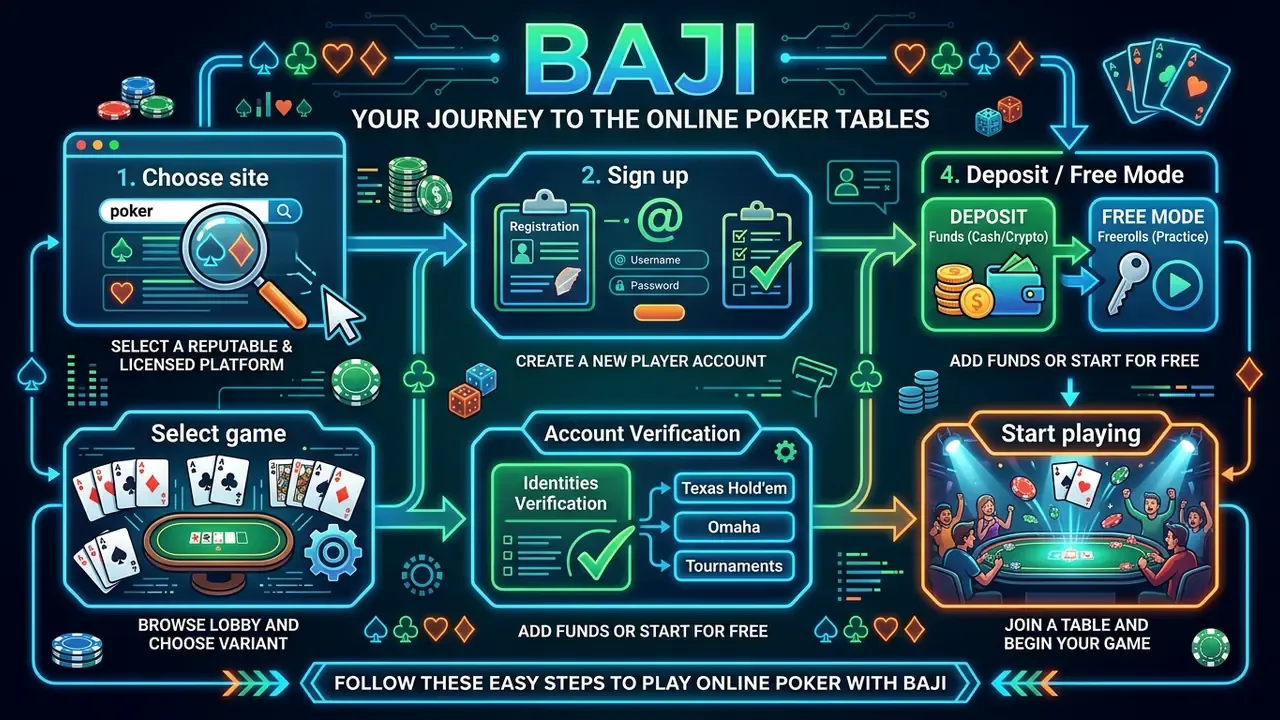
The basic path to your first hand is one uninterrupted sequence: choose site → register → KYC age verification → deposit → select table in the lobby. Nothing mysterious about it.
Legal rooms maximise the simplicity of account creation. Players should not encounter hidden surprises. The main body of verification requirements kicks in not so much at account opening, but at the first withdrawal attempt or when an activity limit is exceeded (AML standards).
To register, the platform will request standard data: name, email address, date of birth and a password. Access to the lobby is granted instantly.
Identity confirmation will require a photo of a government-issued ID and a document showing your address. Many networks open access to free tables immediately after email verification. If you plan to use the mobile app, it is recommended to create your profile through a browser first — this minimises auto-fill errors in forms. One small tip: use the same email you check daily, because time-sensitive bonus codes and tournament tickets often arrive there.
Your first deposit should be calculated at 30–50 buy-ins for the starting microstake. In the lobby, filter tables for "Beginner" status or the lowest blinds (small blinds).
Never sit down at a table with your entire balance. If you are playing cash with blinds of USD 0.01/0.02, the minimum buy-in is about USD 2. You need enough reserves to weather variance comfortably. Choose 6-max format tables — they are more dynamic and teach faster adaptation to positions. Full-ring (9-handed) tables are slower and more passive, which can be useful later but tends to bore beginners into making careless plays.
At the exploration stage, users most frequently search for explanations of terms (showdown, ante), try to understand the difference between formats and worry about legality. Here are the questions that come up again and again.
Court precedents — such as United States v. DiCristina (2012) — and empirical research by mathematicians have confirmed: online poker is a game of skill, and luck affects only short intervals (individual sessions). A strong player captures positive expected value through superior decisions, turning luck into a statistical rounding error over tens of thousands of hands. Academic literature increasingly frames poker within the concept of "sportification" — recognising certain competitive poker events as legitimate skill-based competitions. — "Comprehensive Landscape of Online Poker" (2024).
"The Role of Skill Versus Luck in Poker: Evidence from the World Series of Poker" — S. Levitt, T. Miles (2010), peer-reviewed economics research: the authors demonstrated that tournament results statistically depend on player skill, not randomness.
The short answer? Luck decides a single hand. Skill decides a career.
Playing from a smartphone is convenient thanks to portrait-native modes and buttons designed for one finger. However, the professional experience on mobile is limited. On a phone, it is impossible to comfortably run a statistical HUD, and multi-tabling space is severely constrained. For educational micro-sessions — say, 20–30 minutes during a commute — the mobile version is sufficient. But analytical grinding still requires a desktop setup with a proper screen.
The legal status of online poker in Bangladesh falls under a grey area. The country's Public Gambling Act 1867 (inherited from colonial-era legislation) and subsequent amendments prohibit operating a gambling establishment on Bangladeshi soil, but the law does not explicitly address an individual who plays on an offshore-licensed international platform from their own device. No cases of prosecution targeting individual online poker players have been publicly documented in Bangladesh as of 2025. That said, ISPs may restrict access to gambling domains, and domestic banks frequently block outbound card transactions flagged as gambling-related. Players in this region commonly use VPNs and cryptocurrency for access and deposits.
Important: This is not legal advice. Laws evolve, and enforcement may change. Consult a local legal professional before placing any real-money bets from Bangladesh.
Direct Visa/Mastercard deposits are frequently declined by Bangladeshi banks. Mobile wallets like bKash and Nagad are not yet supported by major offshore poker rooms. The most practical path is: purchase USDT or Bitcoin on a local peer-to-peer exchange → deposit cryptocurrency directly into the poker room. Crypto deposits are typically instant and carry no banking blocks. For withdrawals, the reverse process applies — the room sends crypto to your wallet, and you convert locally. Keep records of every transaction for your own protection.
When a player bets all their remaining chips (goes "all-in") but has fewer chips than other active players, a side pot is created. The all-in player can only win the main pot (matching their contribution). The remaining players continue betting into the side pot, which only they are eligible to win. This rule ensures fairness when stack sizes differ at the table. It sounds complicated in theory, but after seeing it happen two or three times at a real table, the mechanic becomes intuitive.
Nadia Farzana Haque leads the editorial team at iGaming Bangladesh. She has spent over four years covering the iGaming industry across South and Southeast Asia, focusing on responsible gambling policy, platform security and player education. Her reviews are informed by hands-on testing of real accounts — including deposits, withdrawals and live-session play — across every platform discussed in this guide.